



The Ultimate Guide to Cisco Integrated Services Routers Features, Benefits | Best Rates | Buying Guide | Detailed Tips | Maintenance | FAQ |, and Buying Tips
The Ultimate Guide to Cisco Integrated Services Routers: Features, Benefits, and Buying Tips
With the current digital-first business environment, secure and high-performance networking is the backbone of any successful business. Whether you operate a small office or a multi-branch organization, your network infrastructure must be fast, scalable, and secure. That's where Cisco Integrate Services Routers (ISRs) come in.
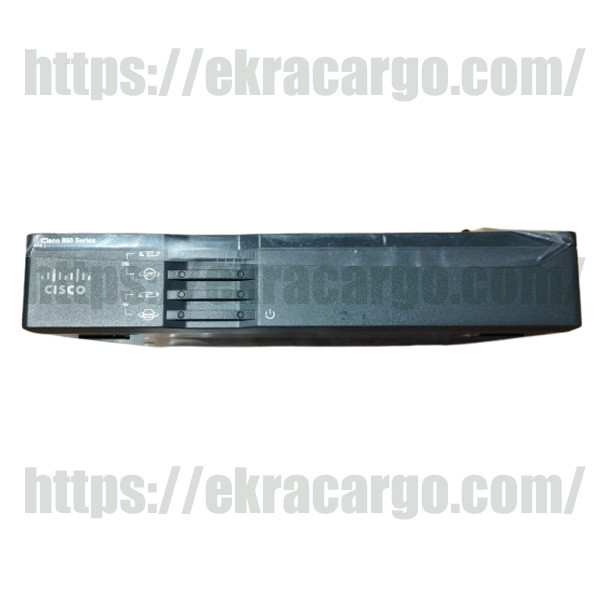
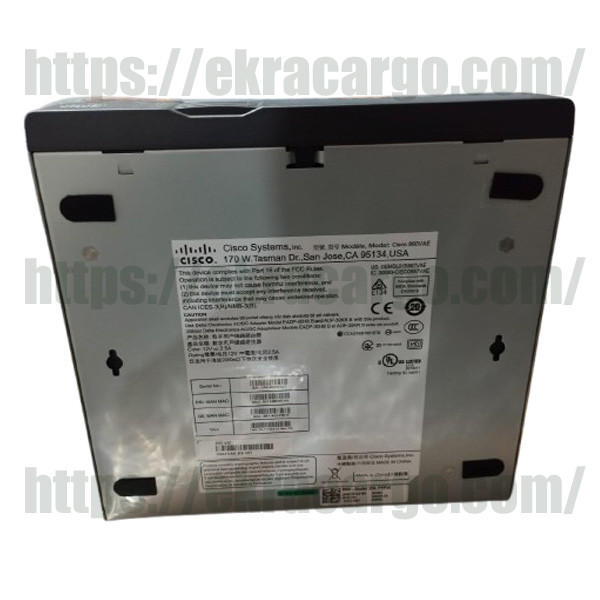
Check the product at Ekra Cargo
Cisco
ISRs are more than just routers—they are robust, all-in-one networking
solutions offering routing, security, voice, and application services in a
single device. In this comprehensive guide, we’ll dive into:
What
a Cisco Integrated Services Router is
Key
features and benefits
Top
Cisco ISR models and product recommendations
Pros
and cons
A
buying guide for businesses
Frequently
asked questions
Let’s
get started!
What is a Cisco Integrate Services Router?
A
Cisco Integrate Services Router, or ISR, is a modular, scalable router
suitable for small to big-sized businesses. In contrast to common routers
responsible for routing of data only, ISRs integrate diverse IT services such
as:
Routing
Firewall
security
VPN
Unified
communications (voice/video)
WAN
optimization
Application
visibility and control
Through
integrating the above, ISRs are highly efficient and economical for companies
that want to consolidate their network infrastructure.
Key
Features of Cisco Integrate Services Routers
These
are the principal features that enable Cisco ISRs to be the IT professionals'
top choice:
1.
Multiservice Support
Cisco
ISRs support many services like VoIP, VPN, and content filtering on a single
appliance. This saves hardware costs and reduces management overhead.
2.
High Performance and Reliability
Designed
for enterprise workload, Cisco ISRs deliver high-speed throughput with
reliability that is suitable for mission-critical applications.
3.
Advanced Security
Some
of the advanced security features are:
-
Cisco IOS Firewall
-
Intrusion Prevention System (IPS)
VPN
(IPSec and SSL)
Content
filtering
This
protects your network from inside and outside.
4.
Modular Design
ISRs
on Cisco have modular interface cards, which allow you to create personalized
configurations with WAN, LAN, voice, and cellular interfaces.
5.
Centralized Management
With
offerings like Cisco DNA Center and Cisco vManage, ISRs can be easily monitored
and configured across remote locations.
6.
Scalability
Whether
you are a small business or growing to multiple branches, ISRs grow with your
business.
Benefits
of Cisco Integrate Services Routers
Less
Complexity – One device with everything, so fewer network appliances to use.
Cost
Savings – Fewer pieces of equipment translate to less hardware, less power
needs, and lower maintenance.
Improved
Asset Security – Built-in security solutions reduce your attack surface.
Improved
Network Performance – Cloud and on-prem optimized for performance.
Remote
Site Connectivity – Ideal for connecting branches or remote sites with secure,
high-performance connectivity.
Top Cisco ISR Models and Product Recommendations
Here
are some of the most reliable Cisco ISR models today, best used for varying
business sizes:
Cisco ISR 1000 Series (Ideal for Small Branches & Offices)
Model:
Cisco C1111-4P ISR
Key
Features:
Up
to 50 Mbps throughputs
4x
LAN ports
1x
SFP WAN
Built-in
Wi-Fi (optional)
Advantages:
Small
and affordable
Supports
SD-WAN
Best
used for small branch offices
Disadvantages:
Limited
throughputs
Fewer
expansion options
Recommended
For: Startups and remote offices with less than 50 users.
Cisco ISR 4000 Series (Suitable for Medium to Large Companies)
Model:
Cisco ISR 4331
Key
Specs:
100
Mbps to 300 Mbps throughput (upgradable through license)
3x
NIM slots
Supports
dual power supply
Better
security and voice support
Benefits:
Modular
and scalable
Suitable
for WAN aggregation
High
feature set
Drawbacks:
Larger
footprint
Higher
initial cost
Recommended
For: Medium to large offices or data centers of up to 200 users.
Cisco ISR 4451-X (High-Performance Enterprise Solution)
Key
Specs:
Up
to 2 Gbps throughput
4x
NIM slots
Redundant
power supply support
Heavy-duty
workload support
Advantages:
High
performance
Supports
multiple applications and services simultaneously
Redundant
design to maximize uptime
Disadvantages:
Expensive
Too
much for small business
Recommended
For: Multi-branch designs and large-scale enterprise networks.
Buying Guide: How to Choose the Right Cisco ISR
While buying a Cisco Integrated Services Router, consider the following:
1.
Network Size & User Count
Choose
a model that handles your user load comfortably. The ISR 1000 series can be
used for small offices, while large businesses can utilize ISR 4000 series
models.
2.
Services You Need
Do
you need high-end security, voice, VPN, or SD-WAN capabilities? Ensure that the
model provides your desired services.
3.
Scalability
If
you expect future growth, purchase a modular, scalable ISR that can grow in the
future.
4.
Budget
Though
ISRs are expensive to acquire, they save money in the long term due to
consolidation and reduced maintenance requirements.
5.
Redundancy and Uptime Needs
Mission-critical
use requires models with failover and redundant power support (e.g., 4451-X).
Pros
and Cons of Cisco Integrate Services Routers
Pros Cons
Extremely
high reliability and uptime More
expensive up-front
Integrated
services (routing, VPN, security) Licensing
can be complex
Modular
and scalable Might be overkill for
tiny configurations
Centralized
easy management Larger units consume rack
space
First-class
security capabilities
Easier
learning process for beginners
Why Cisco ISR is a Smart Investment
Cisco
is a well-established and recognized enterprise networking company, and its
ISRs are battle-tested in various industries—finance, healthcare, education.
With security, performance, and flexibility embedded, Cisco ISRs translate to
peace of mind and long-term value.
Whether
you are rolling out a single branch or managing a multi-site business, these
routers provide a firm foundation for secure, scalable growth.
Cisco Integrated Services Routers FAQs
❓
How does an ordinary router differ from a Cisco ISR?
An
ordinary router just performs basic routing. An ISR integrates routing,
security, and additional services like VPN, voice, and WAN acceleration into a
single device.
❓
Do Cisco ISRs support Wi-Fi?
Some
of the ISR 1000 series comes with wireless capability integrated, ideal for
small offices.
❓
How long will a Cisco ISR last?
With
firmware and constant maintenance, most Cisco ISRs can last 5 to 7 years or
more.
❓
Can I utilize a Cisco ISR for SD-WAN?
Yes!
Most newer Cisco ISRs support SD-WAN features, especially with the 1000 and
4000 series.
❓
Do I require special licenses for high-end features?
Yes, high-end security, performance optimizations, or voice functionality tends to require additional Cisco software licenses.
Final
Thoughts
A
Cisco Integrated Services Router is an investment into the long-term security
and wellness of your network. Whether you're a large business or growing SMB,
Cisco has a model that suits your needs. Their integrated all-in-one design
reduces complexity, increases dependability, and adapts to your business.
If
you're looking for an endurable solution to future-proof your infrastructure, a
Cisco ISR is the solution.
Ready to Buy a Cisco Integrated Services Router?
Check
out our bestsellers for Cisco ISR here and pick the one that best meets your
business requirements.


Ekracargo.com - Your trusted partner in industrial efficiency, providing a wide range of premium quality spare parts at competitive prices.
Contact Info
- Address: House 54 | Road 14 | Sector 14 | Uttara | Dhaka 1230 | Bangladesh
- Phone: Contact: +8801634736139 (WhatsApp) ,+8801789394669 (WhatsApp)
- Email: info@ekracargo.com
